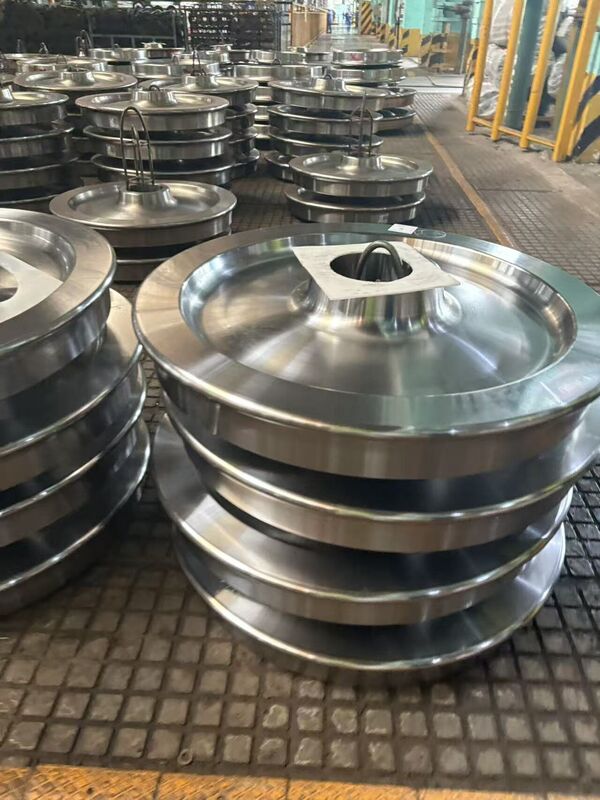
Steel railway wheels for metro and passenger rail systems are designed to provide stable running performance, smooth wheel-rail contact, and long-term operational reliability.
These forged wheels are suitable for urban transit systems operating under frequent acceleration and braking cycles.
Manufactured according to EN13262 requirements, they provide balanced wear resistance and fatigue performance for passenger applications.
These steel railway wheels are widely used in:
ER7 provides balanced strength and wear resistance.
ER8 can be selected where higher loads and extended service life are required.
The wheel profile is optimized to improve wheel-rail contact conditions and support smooth operation.
Suitable for metro cars, passenger rail vehicles, and urban transit fleets.
This hardness range supports both wear resistance and running comfort.
Forging and CNC machining improve profile accuracy and operational consistency.
Key parameters:
These parameters affect:
Passenger Comfort → wheel profile accuracy and stability
Operational Safety → flange geometry and dimensional precision
Service Life → hardness and material performance
Maintenance Interval → wear resistance and heat treatment quality
System Compatibility → bore dimensions and wheel diameter
| Item | Specification |
|---|---|
| Material | ER7 / ER8 |
| Diameter | 700–920 mm |
| Hardness | 250–320 HB |
| Standard | EN13262 |
| Flange Height | 28–35 mm |
| Flange Thickness | 27–33 mm |
| Rim Thickness | 60–75 mm |
| Bore Diameter | 110–240 mm |
| Heat Treatment | Quenching & Tempering |
| Inspection | UT / MT / Hardness / Dimensional |
Metro systems → ER7
Urban rail transit → ER7
Passenger rail → ER7 / ER8
Long service cycles → ER8
Standard passenger service → ER7
Higher passenger density → ER8
Frequent acceleration and braking → controlled hardness recommended
700–780 mm → compact metro systems
780–850 mm → standard metro vehicles
850–920 mm → passenger and suburban rail systems
These steel railway wheels help solve:
They improve stability, reduce maintenance, and extend service life.
Q1: What material is commonly used for passenger railway wheels?
ER7 is commonly used, while ER8 is recommended for higher load conditions.
Q2: Can these wheels be customized according to drawings?
Yes. Customized dimensions and wheel profiles are available.
Q3: Is third-party inspection available?
Yes. Third-party inspection and complete test reports can be provided before delivery.